Data Analyst Salary in Mumbai in 2026 A Complete, Level-by-Level Breakdown
Most freshers choose the wrong course first. This guide shows the right sequence role, skills, projects, presence, interviews for IT jobs in Thane 2026.
I
ITDaksh Team
· 20 May 2026 ·17 min read
Share:
Contents
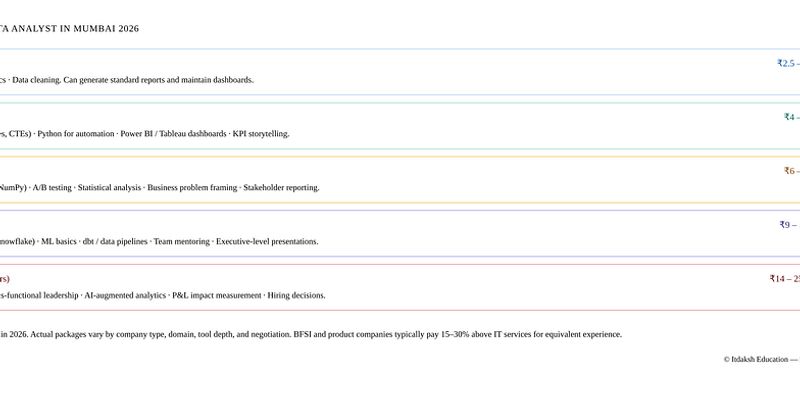
Appears at the very top of the blog, before the opening section. Description: A branded header infographic displaying the headline "Data Analyst Salary in Mumbai in 2026" with a visual representation of the salary spectrum — from ₹2.5 LPA at the entry level rising to ₹25+ LPA at the analytics leadership level — likely using a gradient bar, arrow, or tiered layout to show the salary progression at a glance.
Direct Answer
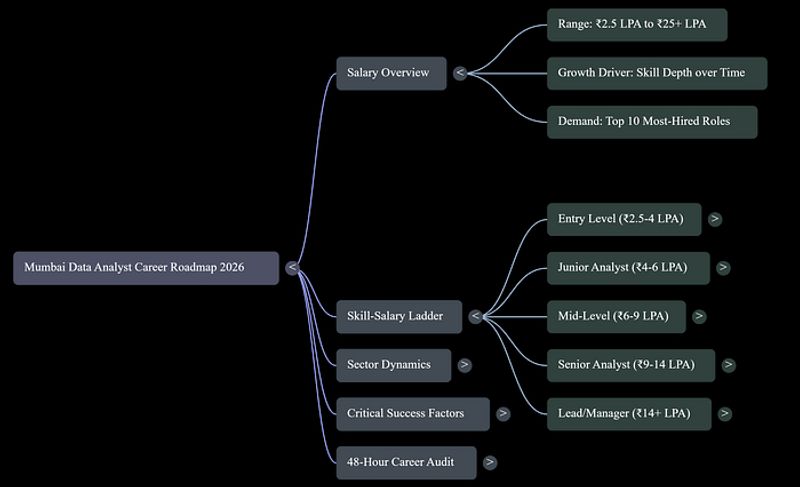
A Data Analyst in Mumbai earns between ₹2.5 LPA at the entry level and ₹25+ LPA at the senior leadership level in 2026 but the number that matters most is not the average. It is which specific skills move you from one salary band to the next, and how fast.
Most salary articles give you a range and stop there. That is useful for benchmarking but useless for growth. If you are a fresher deciding whether Data Analytics is worth pursuing, or a working analyst wondering why your salary has not moved in two years, the range alone tells you nothing. What you need is the map skill by skill, level by level that explains exactly what justifies each number in Mumbai’s job market right now.
This is that map.
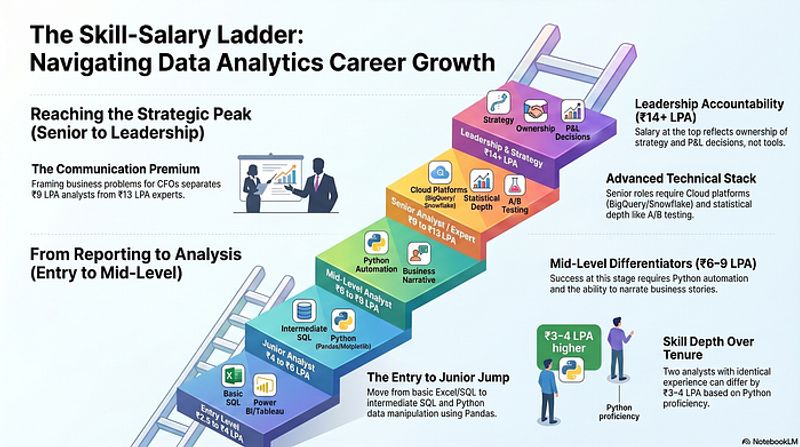
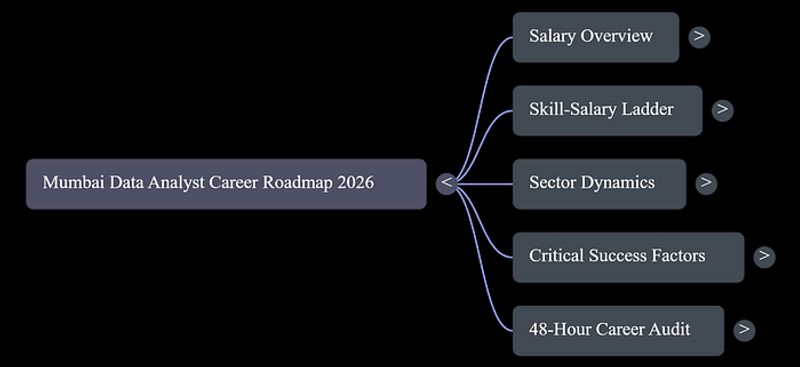
A supporting visual likely a summary card or pull-quote graphic reinforcing the core article premise that salary in Data Analytics is driven by skill depth rather than years of experience, setting the framing for the level-by-level breakdown that follows.A visual framework or ladder diagram showing the five Data Analyst salary levels in Mumbai — Entry, Junior, Mid-Level, Senior, and Analytics Lead — with corresponding salary ranges and the key skills or tool additions required to progress from one level to the next.A visual framework or ladder diagram showing the five Data Analyst salary levels in Mumbai — Entry, Junior, Mid-Level, Senior, and Analytics Lead — with corresponding salary ranges and the key skills or tool additions required to progress from one level to the next.
Introduction : Why Mumbai Is One of the Best Cities in India for a Data Analyst Career
Mumbai is not just a large job market. It is a structurally diverse one. The city houses the entire spectrum of sectors that generate and act on data at scale BFSI, e-commerce, pharma, FMCG, media, consulting, and technology. Each sector uses data analysts differently, pays differently, and values different tools in its hiring decisions.
A Data Analyst at a fintech startup in Powai operates very differently from one at a large bank in BKC, which operates differently from one at a pharma company in Andheri. This diversity is why Mumbai salaries have a wider range than most Indian cities. The ₹2.5 LPA to ₹25 LPA spread is not random it reflects the distance between a junior analyst generating Excel reports at an IT services firm and a senior analytics lead running data strategy at a product company. Understanding which end of that range you are targeting and what it takes to get there is the only way to treat this salary data usefully.
According to data aggregated from LinkedIn Salary Insights, Naukri, AmbitionBox, and Glassdoor India, Data Analytics consistently appears in the top 10 most-hired roles across Mumbai’s job market in 2026. The demand has not softened despite broader macroeconomic uncertainty in parts of the global IT sector. If anything, companies that cut software development teams have leaned harder on analytics to get more insight from existing data which means the demand for skilled Data Analysts has remained remarkably stable.
The Skill–Salary Ladder: What Each Level Actually Requires
A detailed Skill–Salary Ladder infographic mapping specific tools and competencies to each salary band — showing Excel and basic SQL at Entry level, Python and intermediate SQL at Junior level, Python automation and communication at Mid-level, cloud platforms and statistics at Senior level, and strategy and leadership at the Analytics Lead level.
(See the visual framework above)
The most important concept in this entire article is one that most salary guides never explain: salary in Data Analytics is not a function of time. It is a function of skill depth. Two analysts with identical experience levels can earn salaries that differ by ₹3 to ₹4 LPA because one has added Python proficiency and the other has not. Two senior analysts with six years of experience can differ by ₹6 LPA because one can own end-to-end data strategy and the other can only execute tasks assigned by others.
Time gets you from level to level by default if you stay in the same role and do the same work. Skills get you there faster, and they allow you to jump levels rather than climbing one rung at a time.
Entry Level ₹2.5 to ₹4 LPA
At the entry level, a Data Analyst in Mumbai is expected to handle structured data mostly in Excel and SQL generate standard reports, maintain pre-built dashboards, and support senior analysts with data extraction and cleaning. The tools are Excel, basic SQL (SELECT, WHERE, GROUP BY, ORDER BY), and Power BI or Tableau at a foundational level.
The ceiling in this band is not low because the work is unimportant. It is because the work is replaceable. Anyone with two months of training can do it. The companies that hire at this level are primarily IT services firms and mid-sized businesses that need reliable data processing rather than strategic insight. This is an entry point, not a destination.
Junior Analyst ₹4 to ₹6 LPA
The first meaningful salary jump in Data Analytics happens when you move beyond reporting and into analysis. This requires intermediate SQL the ability to write joins across multiple tables, use subqueries and CTEs, and design queries that answer business questions rather than just retrieve data. It requires Python proficiency at the Pandas level data manipulation, cleaning automation, and basic visualisation using Matplotlib or Seaborn. And it requires the ability to build a meaningful dashboard that tells a business story rather than just displaying numbers.
This is the level where most trained freshers from structured programmes enter the market. At Itdaksh Education, the Data Science & Analytics programme is specifically designed to take students to this level before placement begins building SQL from basics to intermediate complexity, introducing Python with Pandas and NumPy, and requiring students to build and present at least one complete dashboard project as part of their capstone work. The students who enter interviews at this skill level rather than the entry level consistently receive stronger offers.
This is where the majority of active Data Analyst job postings in Mumbai sit in 2026. It is also the level where the skills gap between candidates is widest which is why so many analysts stay here for years without moving up, and why those who do move through it quickly earn disproportionate rewards.
The differentiator at this level is Python depth combined with business communication. An analyst who can write a Python script to automate a weekly data pipeline, saving a business team four hours of manual work every week, is providing quantifiable value. An analyst who can take complex data and translate it into a clear, structured narrative for a non-technical stakeholder is providing strategic value. Both of these are learnable skills. Neither is taught in most generic online courses, because they require structured practice under real feedback not video tutorials.
According to AmbitionBox data for Mumbai, the median Data Analyst salary across all sectors sits between ₹5.5 and ₹7 LPA for professionals with 2 to 4 years of experience. The analysts who earn above the median at this stage are consistently the ones who have added Python to their SQL-and-BI foundation not those who simply have more years on their resume.
Senior Analyst ₹9 to ₹14 LPA
At the senior level, the tools shift to include cloud data platforms BigQuery for companies using Google Cloud, Snowflake or AWS Redshift for others and data transformation frameworks like dbt. Statistical depth matters: A/B testing, cohort analysis, regression, and hypothesis testing are standard expectations rather than impressive additions.
But here is what most senior-level analysts underestimate: the hard jump at this level is not technical. It is communicative. A senior analyst who can present findings to a CFO, explain the limitations of a dataset honestly, and recommend a business decision based on data not just describe what the data shows commands a salary premium that no SQL skill alone can generate. The ability to frame a business problem, choose the right analytical approach, and communicate the result with confidence is what separates a ₹9 LPA analyst from a ₹13 LPA one with identical tools.
Analytics Lead and Manager ₹14 LPA and Above
At this level, individual technical output becomes secondary to strategy, team direction, and business impact. Analytics leads own data infrastructure decisions, mentor junior analysts, define the metrics that matter to the business, and sit in rooms where P&L decisions are made. The salary reflects accountability, not tool proficiency.
This level is not the immediate destination for a fresher in 2026 but understanding it from the beginning shapes your career decisions at every earlier stage. Analysts who build communication skills, take on ownership at each level, and stay technically current are the ones who reach L5 in 6 to 8 years. Those who execute tasks without ever owning outcomes remain at L2 or L3 indefinitely, regardless of experience.
The Company Type Effect: Same Skills, Different Paycheques
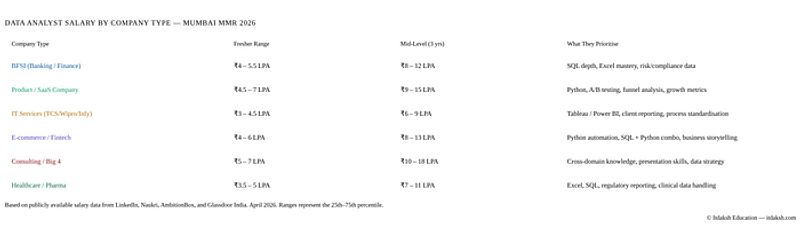
A sector-by-sector salary comparison table for Data Analysts in Mumbai, showing salary ranges and growth trajectories across BFSI companies (BKC, Nariman Point), product and SaaS companies (Powai, Andheri), IT services firms (TCS, Wipro, Infosys tier), and consulting firms — illustrating how the same skills earn materially different salaries depending on the sector chosen.
(See the sector salary table above)
The same SQL and Power BI skills can earn you ₹3.5 LPA at one company and ₹5.5 LPA at another not because of your performance, but because of the sector you chose to enter. This is one of the most underappreciated salary dynamics in Data Analytics, and most freshers make this mistake without realising it.
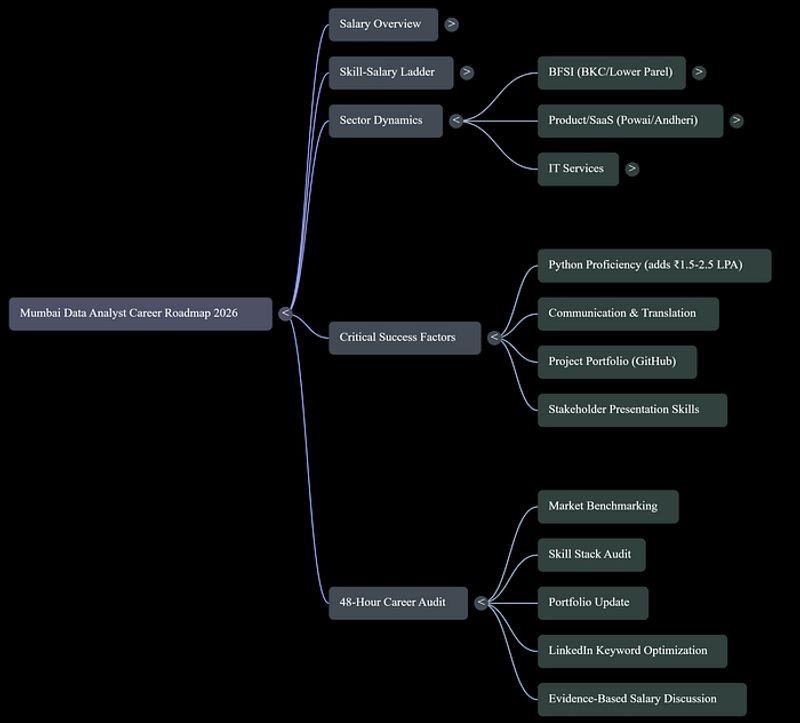
BFSI companies banks, insurance firms, NBFCs, and financial services companies concentrated in BKC, Nariman Point, and Lower Parel pay among the highest in Mumbai at every experience level. They have complex, high-value data and regulatory requirements that create genuine demand for skilled analysts. The trade-off is a more structured, compliance-conscious work environment and a steeper entry requirement in terms of SQL and Excel depth.
Product and SaaS companies, concentrated in Powai, Andheri, and increasingly in Thane, pay the highest ceiling salaries and offer the fastest growth trajectories. They also have the sharpest interview processes Python proficiency, problem-solving tests, and business case analysis are standard. For a fresher who is willing to invest in Python alongside SQL and BI tools, a product company role is worth targeting even if it takes 2 to 3 additional months of preparation.
IT services firms the TCS, Wipro, Infosys, and Capgemini category offer the easiest entry points and the most predictable increments. They are not the highest-paying, but they are the most accessible and provide genuine working experience that is valued in subsequent job searches. Many of the Data Analysts who eventually land high-paying roles at product companies or BFSI firms spent their first 1 to 2 years in IT services building real working proficiency.
The Contrarian Truth About Data Analyst Salaries Nobody Publishes
Here is the insight that most salary guides carefully avoid: the single biggest salary gap in Data Analytics in Mumbai is not between experience levels. It is between analysts who can communicate data and those who can only process it.
The common assumption is that adding more technical tools learning Tableau after Power BI, or adding DAX after SQL is what drives salary growth. It does contribute. But the analysts earning in the top 20% of their experience band the ones consistently above the range medians shown above almost universally have one additional skill that their peers do not: they can explain what data means for a business decision, not just what it shows.
A dashboard is a product. The ability to walk a CEO or department head through that dashboard, explain the trends in plain language, flag the risks in the numbers, and recommend an action this is a skill that companies pay a meaningful premium for, because it is rare. It requires domain understanding, logical reasoning, and communication confidence that most technical training programmes never explicitly develop.
At Itdaksh Education, we recognise this gap and address it directly. In our Data Science & Analytics programme, students do not just build projects they present them. Every capstone review includes a simulated stakeholder presentation where students must explain their analysis to a non-technical audience, defend their methodology, and answer questions under pressure. This is the closest approximation of what a real analyst does in a business environment, and it is the preparation that produces analysts who earn above the median from their first role.
This is the question that matters most to working analysts. Not “what is the average?” but “what do I do next to earn more?”
The answer is different depending on where you currently sit on the ladder.
If you are at the entry level earning ₹2.5 to ₹4 LPA, the single most impactful action is learning Python with Pandas. SQL and Excel alone are commoditised skills at this level thousands of analysts have them. Python automation skills are not commoditised. An analyst who can write a Python script to clean, transform, and visualise data is offering something the majority of entry-level analysts cannot. This single addition moves most analysts from the ₹3 LPA band to the ₹5 to ₹6 LPA band in their next role.
If you are at the junior level earning ₹4 to ₹6 LPA, the highest-value move is building a visible portfolio of business problems you have solved. Not skill certificates projects. A GitHub repository with three well-documented analysis projects, each solving a real business question, gives a hiring manager at a product company or BFSI firm tangible evidence of your capability. Certificates tell them you attended something. Projects tell them what you can do.
If you are at the mid-level earning ₹6 to ₹9 LPA and stagnating, the bottleneck is almost always communication, not tools. Invest deliberately in stakeholder communication present at team meetings, write structured data narratives, volunteer for cross-functional projects where you must explain data to non-analysts. This is the rung where soft skills deliver harder salary outcomes than technical additions.
Tactical Section: Step-by-Step How to Audit Your Own Salary Position in 48 Hours
If you are a working Data Analyst and want to know whether you are being paid fairly, do this exercise. It takes less than two days and will give you a clear, evidence-based answer.
Step 1 Benchmark yourself.
Search your exact job title on LinkedIn Jobs and filter for Mumbai. Set the filter to “Easy Apply” and look at job postings in your experience range. Read the requirements. Check the salary bands displayed (LinkedIn now shows estimated ranges on many postings). This gives you a live market benchmark not a historical average.
Step 2 Audit your skill stack.
Write down every tool you use at work with an honest proficiency level: basic, intermediate, or advanced. Then check it against the L2 and L3 requirements in the Skill–Salary Ladder above. The gap between where you are and where the market is paying more is your skill development roadmap.
Step 3 Check your portfolio.
Open your GitHub or portfolio. If it is empty, or if the last project is from your training programme, this is the most urgent thing to fix. Add one new analysis project in the next 30 days using publicly available data from Kaggle or data.gov.in. Document it clearly. This alone changes how interviewers perceive your current activity level.
Step 4 Update your LinkedIn with keywords.
Search for senior Data Analyst roles in Mumbai you want to target. Note the tools and skills they mention. Add every applicable one to your LinkedIn Skills section and About paragraph. Recruiters are searching for these exact keywords. Visibility precedes opportunity.
Step 5 Have the conversation.
If you have been at the same company for 18 months or more with consistent performance, schedule a salary review conversation using the market data you just collected. Come with numbers not feelings. “Based on current market benchmarks for an analyst with my tools and experience in Mumbai, roles are offering ₹X to ₹Y. I want to discuss aligning my compensation.” This framing is professional, evidence-based, and far more effective than general dissatisfaction.
Factor2020 Landscape 2026 Landscape Entry-level salary₹2–3 LPA common ₹3–5 LPA for skilled freshers SQL-only value Sufficient for many roles Commoditised Python adds real premium Power BI / Tableau”Nice to have”Standard expectation at L1 Python for analysts Advanced skillMid-level expectation Cloud platforms Rare requirement Increasingly standard at senior level Portfolio requirement Optional Near-mandatory for above-median offers Communication as salary driver Undervalued Explicitly rewarded Remote/hybrid availability Rare Common, especially at product companies Highest ceiling for top analysts₹15–18 LPA₹25 LPA+ at strategy level
FAQs
Q1: What is the average Data Analyst salary in Mumbai for freshers in 2026?
A genuinely skilled fresher with intermediate SQL, Power BI or Tableau proficiency, basic Python, and a portfolio project can realistically expect ₹3 to ₹5 LPA in Mumbai for their first role. The range reflects company type more than skill variation at the entry level: product companies and BFSI firms start higher than IT services firms. A fresher who enters with only Excel and basic SQL, without Python or a project, typically earns ₹2.5 to ₹3.5 LPA which is why skill investment before job hunting matters.
Q2: How much can a Data Analyst earn in Mumbai after 3 years of experience?
With 3 years of experience and a skill stack that includes advanced SQL, Python (Pandas, NumPy, automation scripting), and strong visualisation in Power BI or Tableau, a Data Analyst in Mumbai can realistically target ₹7 to ₹10 LPA. The upper end requires either BFSI or product company employment, or a demonstrable track record of delivering business outcomes not just executing data tasks. Analysts who remain in IT services without broadening their tool stack typically earn ₹6 to ₹8 LPA at this stage.
Q3: Does learning Python really make a difference to a Data Analyst’s salary in Mumbai?
Yes, and the difference is measurable rather than marginal. Based on salary data across LinkedIn and Naukri for Mumbai, Data Analyst roles that list Python as a requirement offer median packages approximately ₹1.5 to ₹2.5 LPA higher than equivalent roles that do not. This is consistent across sectors. Python’s ability to automate data workflows, handle larger datasets than Excel, and bridge the gap toward machine learning makes it a genuine productivity multiplier and companies pay for productivity multipliers.
Q4: Is Data Analytics a good career choice in Mumbai in 2026 is the salary worth it?
Yes, with important context. Data Analytics is one of the most accessible IT entry points in terms of learning curve especially for non-CS graduates and one of the most durable in terms of demand. The salary growth curve rewards consistent skill investment more directly than most other IT roles, which means discipline in learning translates predictably into career and salary outcomes. The investment in structured training typically ₹30,000 to ₹60,000 for a quality programme pays back within 4 to 6 months of the first employed salary at the ₹3 to ₹4 LPA entry point.
Q5: What is the highest Data Analyst salary in Mumbai?
Analytics leads and data strategy managers at product companies, fintech firms, and Big 4 consulting firms in Mumbai earn ₹20 to ₹30 LPA at the top of their bands. These roles require 6 to 10 years of progressive experience, cross-functional leadership capability, cloud data platform expertise, and the ability to own data strategy at a business level not just execute analysis. The highest salary drawn among Itdaksh Education’s placed Data Analytics alumni is 8 LPA, reflecting what a well-prepared fresher-to-mid-career transition can achieve within the first 2 to 3 years of employment.
Q6: How is a Data Analyst salary in Mumbai different from Thane or Navi Mumbai?
The salary difference between Thane, Navi Mumbai, and Mumbai’s central business districts is narrowing as companies establish offices across the Mumbai Metropolitan Region. For freshers and junior analysts, roles in Airoli, Turbhe, Mahape, and Thane West now offer comparable packages to roles in Andheri and Powai, with the added advantage of reduced commute time and cost. For senior roles, BKC, Nariman Point, and Lower Parel still command the highest packages due to concentration of BFSI and consulting firms.
(Read more: [Insert Internal Link Top IT Companies Hiring Data Analysts Near Thane and Navi Mumbai 2026])
Key Takeaways
Data Analyst salary in Mumbai in 2026 ranges from ₹2.5 LPA at entry level to ₹25+ LPA at the analytics leadership level but time alone does not move you through these bands. Skill depth does.
The Skill–Salary Ladder has five rungs: Entry (Excel + basic SQL), Junior (intermediate SQL + Python + BI tools), Mid-level (advanced SQL + Python depth + A/B testing), Senior (cloud platforms + statistical analysis + stakeholder leadership), and Manager (data strategy + business ownership).
Company type has a greater impact on salary at every level than most analysts realise. BFSI, product companies, and consulting firms consistently pay 15 to 30% above IT services for equivalent skills.
The single biggest salary driver that most training programmes never teach is communication the ability to frame business problems using data and present findings to non-technical stakeholders.
Python is the single highest-ROI skill addition for any Data Analyst currently earning in the ₹2.5 to ₹5 LPA band. It adds ₹1.5 to ₹2.5 LPA to market value in Mumbai at virtually every experience level.
If your salary has not moved in 18 months, the bottleneck is almost certainly a skill or visibility gap not the market. Audit both using the 48-hour exercise in the tactical section above.
Free Resources
Download the Free Data Analyst Skill Roadmap the exact skills, tools, and projects required at each salary level in Mumbai, used by Itdaksh Education students to go from zero experience to ₹3–8 LPA analyst roles in 6 months.
Itdaksh Education 201 Ganesh Tower, Opposite Thane Railway Station, Thane West. ISO 9001:2015 & MSME Certified. Data Science & Analytics | Python | Java | Full Stack. Rated 4.9/5 on Google
#IT career Thane
#fresher IT job India 2026
# zero experience IT
#data analytics Thane
# full stack developer Thane
# IT training institute Thane
#Itdaksh Education
# IT placement Mumbai MMR
# career switch to IT India
#IT fresher guide

 Chat to Support